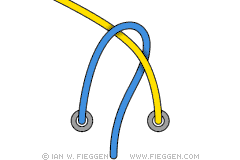
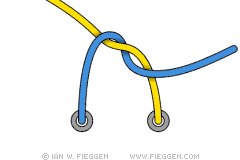
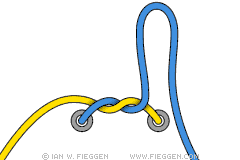
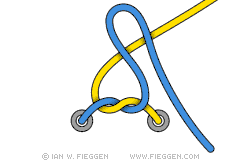
Slipping Shoelaces? Crooked Bows? |
Do your shoelaces always come undone? Do your shoelace bows sit vertically
instead of across the shoe? If so, you're probably tying a "Granny Knot",
and one simple change to your technique will result in a balanced knot that
sits straight and stays secure.
|
This page explains the "Granny Knot" phenomenon in some detail. Put simply:
|
| These diagrams are all drawn as though looking down at your own shoes while tying, and are color-coded to make it easier to follow where the lace runs. The lace end that starts on the left side is Blue and the end that starts on the right side is Yellow. For color-blind visitors, Blue=Dark=Left, Yellow=Light=Right. |
This page is quite extensive and presents a lot of information on the
"Granny Knot". If you'd prefer a simpler video presentation,
Click Here.
What Causes a "Granny Knot"? | |
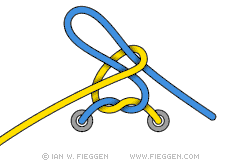
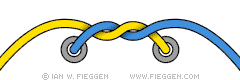
![]() ![]() Right way results in a balanced knot |
Shoelace knots are usually tied in two stages:
Starting Knot followed by
Finishing Bow. Each of these stages "twists" the shoelaces slightly, so it's
important that the two stages be tied in
opposite directions in order to cancel out each other's twists. This balances the knot both visually (the bow sits straight) and functionally (the knot stays securely tied). |
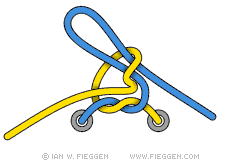
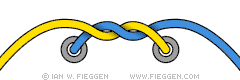
![]() Wrong way results in a "Granny Knot" |
If both stages are tied in the same direction, those twists compound each other, resulting in an un-balanced knot that sits crooked and comes undone more easily. This is commonly known as a "Granny Knot" (or "Slip Knot"). |
|
While there's only a subtle difference in tying technique, there's a big
difference in security. This is not simply an "Old Wives Tale"; it's based
on millennia of established knowledge. In fact, there's even a poem taught
in Scouting, which goes something like:
Right over left, left over right,
The difference is due to the adjacent contact points within the finished
knot. In the balanced shoelace knot, tension on the bottom part of the knot
(due to foot movement) will actually pull the adjacent top part of the knot
tight. In the un-balanced "Granny Knot", the adjacent contact points run in
opposite directions, so the same tension on the bottom part of the knot will
actually work the adjacent top part of the knot loose.
Makes a knot both tidy and tight. | |
Spotting a "Granny Knot" | |
| Balanced Shoelace Knot | Un-balanced "Granny Knot" |
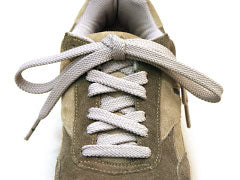
![]() A properly tied shoelace bow should sit sideways across the shoe. |
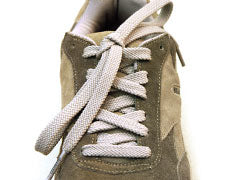
![]() A wrongly tied shoelace bow invariably twists to point "heel-to-toe". |
|
This rule doesn't just apply to shoelaces; crooked bows due to "Granny
Knots" also happen on dresses, aprons, hair ribbons, wedding invitations,
even bow ties, all of which use the same configuration as a
Standard Shoelace Knot. Try tying your shoelace, then shake your shoe a bit and look at how your bow sits. If it's sitting crooked, I'd bet that your shoelaces are always coming undone! | |
Technical Description | |
| Balanced Shoelace Knot | Un-balanced "Granny Knot" |
![]() In knotting terminology, this is known as a "Reef Knot" (or "Square Knot") with "drawstrings" (or "ripcords") (or simply a "Slipped Reef Knot") |
![]() In knotting terminology, this is known as a "Granny Knot" (or "Slip Knot") with "drawstrings" (or "ripcords") (or simply a "Slipped Granny Knot") |
|
While the knotting terminology may sound confusing, it does tell us that
these shoelace knots have basically the same core structure as the well
known rope knots called "Reef Knot" and "Granny Knot", with the only
difference being the "drawstrings" (the ends that are pulled to undo them). These shoelace knots therefore share the same strengths and weaknesses as their rope counterparts, in particular the fact that "Granny Knots" easily come undone. | |
Note that
any shoelace knot, even those considered "secure" shoelace knots,
can end up crooked and less secure if tied wrongly.
Fixing an Un-balanced "Granny Knot" | |||
|
Okay, so you've just realized that you've wasted your whole life tying and
re-tying what turns out to be a "Granny Knot". Don't panic, the solution is
as easy as the problem!
Simply reverse your Starting Knot!
| |||
|
In other words, if you currently tie your starting knot: "Left end over
Right end & through", simply change it to: "Right end over Left end &
through", or vice versa. From the above table of variations, if your method is in the right side (red) of the table, the adjacent method in the left side (green) of the table corresponds to the identical method with a reversed starting knot. You could also choose any of the variations from the left side (green) of the table, such as running around the back instead of around the front or vice versa, or changing left-handed movements to right-handed movements or vice versa. However, most people will find it easier to re-learn the starting knot than to re-learn the finishing bow. | |||
Important Note for Parents / Teachers | |
| If you ever re-tie a child's laces that have come partly undone, especially when re-tying shoelaces that were originally tied by someone else, make sure that you're not inadvertently creating a "Granny Knot"! | |
|
Suppose a child comes to you with laces where the finishing bow has come
undone, yet the starting knot is still intact.
Don't be tempted to take a short-cut! You should always
undo and then
re-tie their starting knot just in case theirs was tied the opposite
way to yours. Otherwise, the end result could be a "Granny Knot", which will
come undone again. Kindergarten teachers and day care providers probably spend more time re-tying kids shoes than anyone else. It's important that they, of all people, know the correct way to tie shoes. They can also help enormously by learning to spot "Granny Knots" and teaching the child and/or their parents how to correct this problem. | |
Note that, like adults, some kids' shoelaces are prone to coming undone
simply because the laces are too slippery. The solution is to either replace
those laces with cotton ones or use
Stride Rite© Keep Tys - Laces Keepers.
Conclusion | |
| Hopefully this page has explained the "Granny Knot", has allowed you to identify whether or not you were tying one, and if so, has enabled you to choose a suitable solution. We also hope that you will keep your eyes open for others with crooked shoelace bows and will pass on this information to them. | |
This shoelace tying information has been provide by Ian Fieggen.
Do your shoelaces always come undone? Do your shoelace bows sit vertically
instead of across the shoe? If so, you're probably tying a "Granny Knot",
and one simple change to your technique will result in a balanced knot that
sits straight and stays secure.
This page explains the "Granny Knot" phenomenon in some detail. Put simply:


How to keep your

Satisfaction Guaranteed
Secure Site